
WFX · Deployed with our partners
From tech packto trade finance.
One record of the order, from the style entering the library to the invoice leaving the building. Costing, materials, procurement, inventory, production, shipping documents and the ledger behind them — in one system rather than seven that have to be reconciled. For a vertically integrated group it reaches further back still, into spinning, knitting, weaving and dyeing.
WFX Cloud ERP is a WFX product. Diverzent leads pre-sales in this region, implements it jointly with WFX consultants, and supports it locally.
The problem it solves
The order exists in nine places and agrees in none.
A buyer order arrives by email and is typed into a sales register. The cost sheet lives in a workbook the merchandiser maintains. Material requirements are worked out again from the BOM, procurement raises its own indents, the warehouse keeps a receipt book, production tracks output on a whiteboard, and finance rebuilds all of it at month end to find out what the order actually earned.
Each of those records is defensible on its own. The problem is the joins between them — every one is a person retyping something, and every retype is a place where the number can change without anyone deciding that it should.
WFX ERP holds one record from the style to the shipment, so the cost sheet, the indent, the goods receipt and the invoice are views of the same order rather than nine parallel accounts of it.
Nobody plans to run nine systems. They accumulate, one workbook at a time.
What sits inside it
The modules, in the order an order moves through them.
The style library, and everything approved against it.
A central catalogue of collections, styles and materials with full tech packs, held online rather than in a shared drive, with a permanent log of every change and who made it.
- Collections organised by brand, season and product type, with costing held per supplier and its history kept.
- Tech packs carrying colourways, specifications, constructions, fabrics and trims, accessible to everyone who needs them.
- Approvals tracked by stage — fits, lab dips, strike-offs, material and garment tests, test reports — with automatic notification to the people waiting.
- Sample orders, sample-room capacity allocation, technical evaluation with image capture on tablet, and carrier tracking after dispatch.
- Style-level risk assessment recorded by the department that owns it, including garment tech and inline inspection.
The software
Two screens from the middle of it.
Not the dashboards. The working screens — where a material requirement becomes a purchase order, and where a delivery becomes stock.
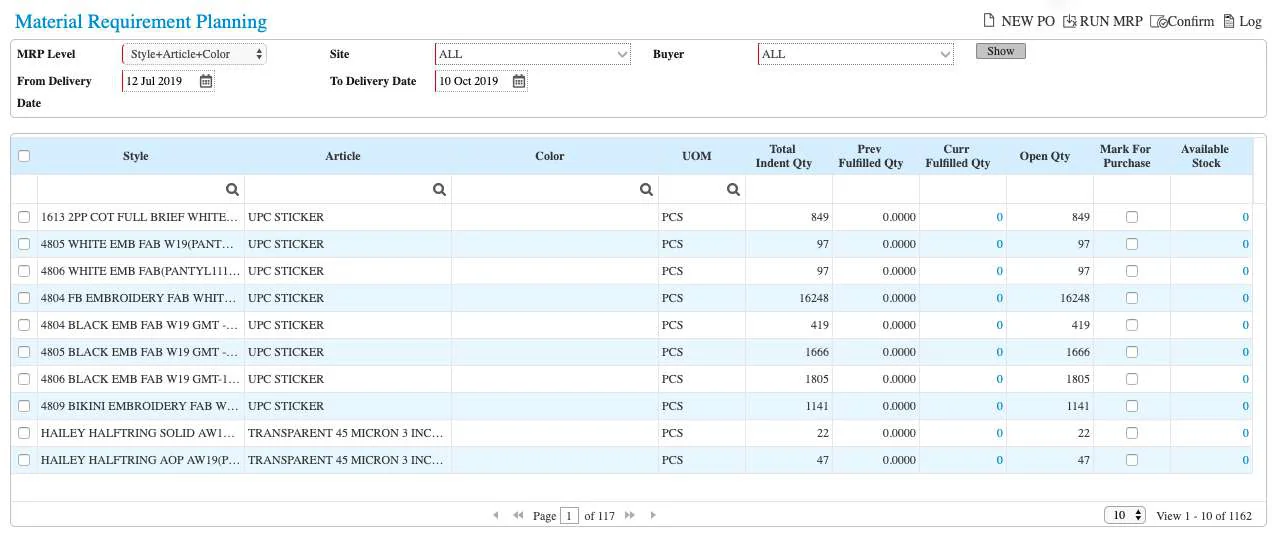
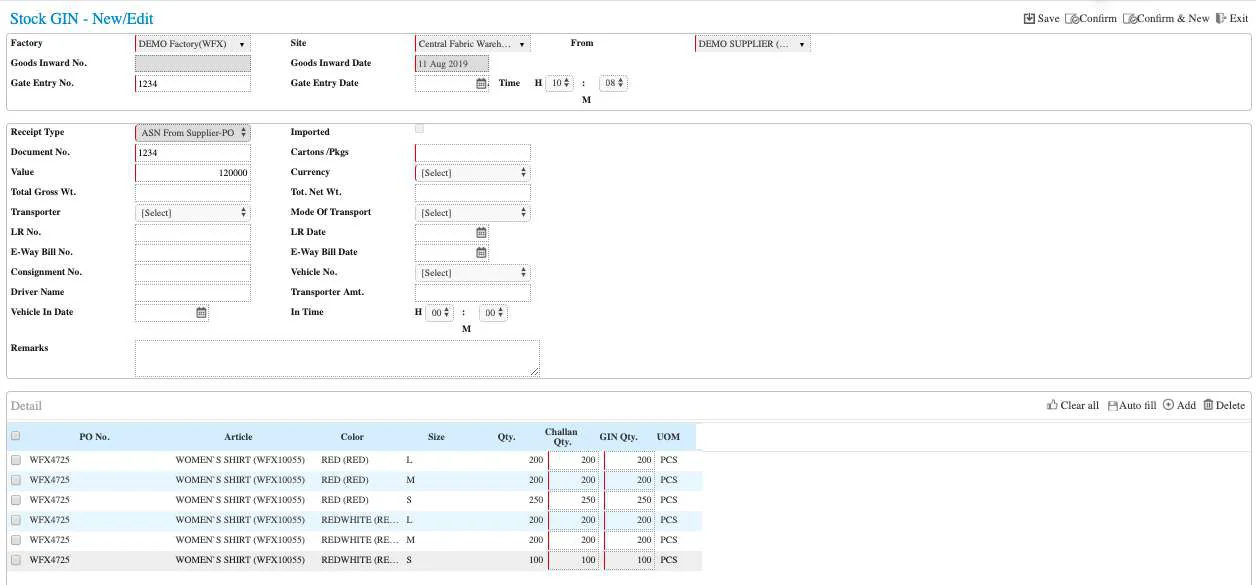
Screens from WFX’s own product presentations, reproduced with the product they belong to. Every image was reviewed at full resolution and anything carrying a buyer, a supplier, an individual or an order number was left out — the underlying data belongs to WFX’s customers and is not ours to publish. What you would see in a demonstration is your own data, not this. These two screens are from a 2022 presentation and the interface has moved on since.
Reporting
What management actually opens.
Reporting is where an ERP either earns its place or quietly stops being used. These are the views WFX ships, and the ones our customers ask for first.
- Order to ship
- Order tracking, work in progress by production and by processor, and a delivery performance scorecard — the sequence a merchandiser is asked about daily.
- Budget versus actual
- Costed against the same structure the budget was approved in, so a variance points at a line rather than at a total.
- Supplier scorecards
- Performance and outstanding amounts by supplier, with the sample-to-order hit ratio behind them.
- Capacity availability
- What is committed and what is free, by unit and by line, before another order is accepted.
- Payables and receivables
- Age-wise analysis with the top five suppliers and buyers surfaced, which is where most of the working-capital conversation actually happens.
- Scheduled to the inbox
- Reports built in a flexible reporting tool and emailed on a schedule, because the report nobody has to log in for is the one that gets read.
WFX
The company behind the software.
600+
customers, in more than 50 countries
35,000+
users on the platform
20+
years building for apparel and textiles
Tell us what you already run.
The useful first conversation is about the systems you have and where they disagree with each other, not about a feature list. Bring that and we will tell you honestly whether WFX is the answer. That conversation is with us; if it goes further, WFX consultants join it.
We answer within one working day.