
WFX · Deployed with our partners
Your CAD team is notthe problem.
Everyone measures marker efficiency, and most factories measure it well. The fabric is lost above the marker — in how many markers there should be, at what ratios, against which grouped rolls. That is a constrained mathematical problem, and it is the one Cut Plan solves.
WFX Cut Plan is a WFX product. Diverzent leads pre-sales in this region, implements it jointly with WFX consultants, and supports it locally.
Where the fabric goes
Fabric is the largest line in the cost sheet and the least planned.
Sewing gets the attention because it is visible, measurable and full of people. Fabric is roughly sixty per cent of the cost of the garment and is largely handled by one CAD planner working against a deadline, in Excel, on a problem with more constraints than a person can hold at once.
Layer length and height, cuttable width, shrinkage group, shade, size-wise quantity, tolerance, fabric actually available in the warehouse. Every constraint added multiplies the combinations. A good planner produces a workable plan. Whether it is the best available plan is not a question anyone can answer by inspection.
And the losses that follow are not in the marker at all. Edge loss from spreading rolls of different cuttable width together. End bits left when a roll runs out mid-lay. Extra patterns carried because shrinkage grouping was done by hand. None of it shows up as poor marker efficiency, which is why a factory can hold excellent marker numbers and still lose fabric.
A percentage point of fabric is usually the whole margin on the order.
In the cutting room
Where the fabric is actually saved.
A cut plan is arithmetic until someone lays the fabric. These are the two places the plan meets the table — the spread itself, and the check before the bundles go up.

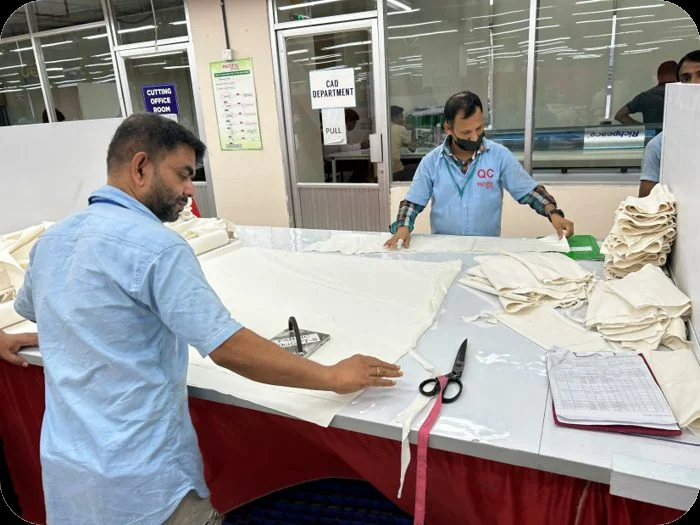
Photographs from a factory running WFX Cut Plan, taken on site. Nothing legible in frame carries a buyer, a supplier or an order number. The floor belongs to the manufacturer, not to Diverzent or to WFX.
How it works
The algorithms, and what each one is actually for.
Group the rolls before you plan the cut.
Rolls are grouped by cuttable width, shade and shrinkage before any planning happens. Done by hand this is paper-and-Excel work; done properly it removes losses that never appear in a marker efficiency figure.
- Automated shrinkage grouping, replacing manual grouping on paper or in Excel.
- Automated width grouping, so rolls of different cuttable width are not spread together and edged off to the narrowest.
- WFX puts edge loss at two to four per cent of fabric, directly or indirectly — a figure that hides inside a good marker number.
- Shade-wise, multi-lot, multi-part and multi-colour planning handled in the same pass.
The software
What a fabric team actually looks at.
Two screens from WFX’s own Cut Plan presentation. The first is where the day starts; the second is where the fabric is actually saved, before a single lay is spread.
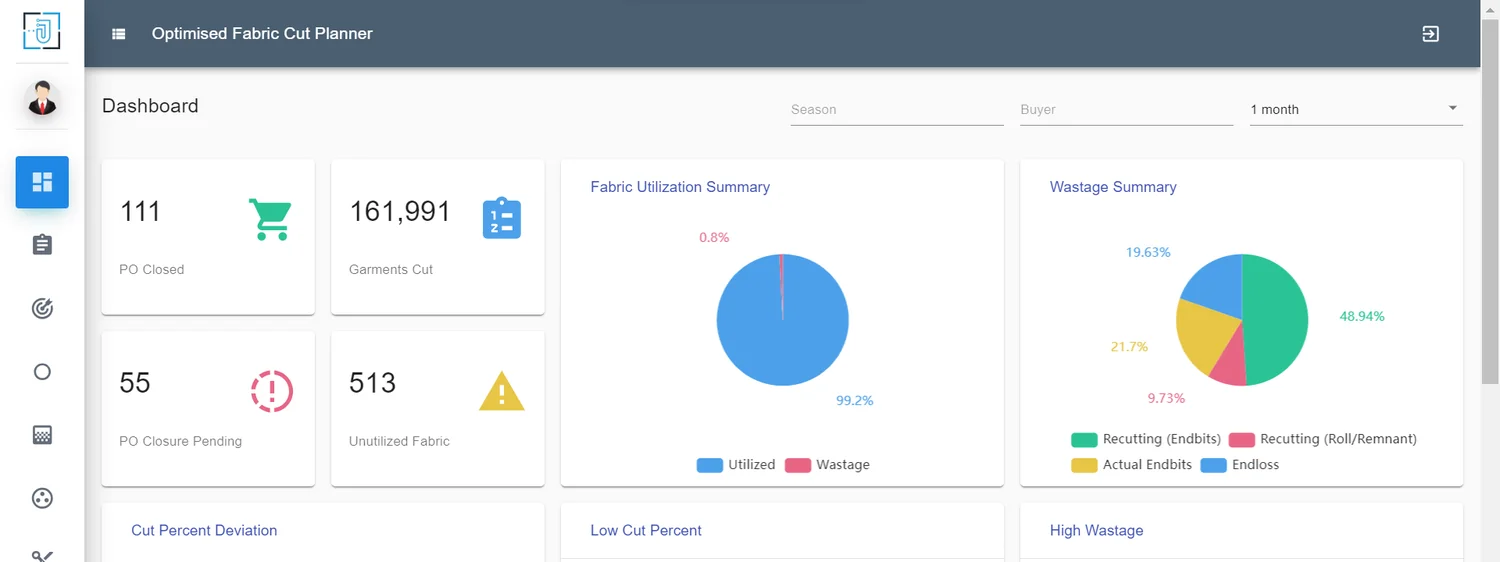
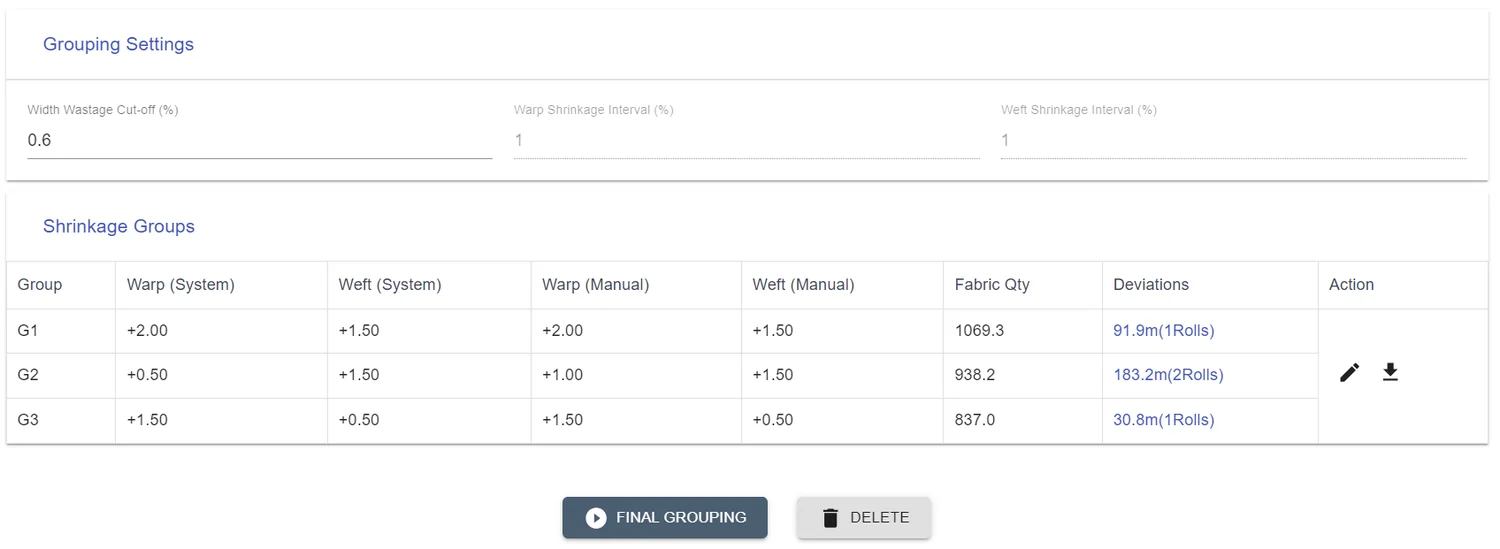
Screens from WFX’s own product presentations, reproduced with the product they belong to. Every image was reviewed at full resolution and anything carrying a buyer, a supplier, an individual or an order number was left out — the underlying data belongs to WFX’s customers and is not ours to publish. What you would see in a demonstration is your own data, not this.
Why it needs everyone
Fabric saving is not a CAD project.
This is the part that decides whether a Cut Plan deployment works. The losses sit between departments, so a project owned by one department recovers a fraction of them.
- The fabric warehouse
- Roll quality has to be updated on receipt — shade, shrinkage, skewness and cuttable width. Every algorithm downstream depends on those four fields being true.
- The CAD team
- Still makes the markers, and makes fewer of them. The planning work moves off their desk; the craft stays on it.
- The cutting floor
- Captures the layslip as it happens instead of writing it up afterwards, which is what makes the reconciliation defensible.
- Fabric suppliers
- Get measured. Width variation and roll length variation become visible as supplier performance rather than absorbed as factory wastage.
- Management
- Reviews a weekly KPI set and the extreme-index orders, rather than every order. The reconciliation report is one click underneath.
- Diverzent and WFX
- WFX consultants bring the product depth; ours bring the local half and the integration into your ERP and ProactivePlan. We are the ones still here for the part after go-live, where most fabric projects quietly stop.
What a deployment delivers
The figures we scope to.
3%
fabric saving
20%
reduction in spreading and cutting time
90%
reduction in planning effort
100%
of end bits tracked from the shop floor
These are the figures Diverzent works to when scoping a Cut Plan deployment, and they are deliberately more conservative than the numbers in the vendor’s marketing. On a garment where fabric is around sixty per cent of cost, three per cent is not a rounding error — it is usually the difference between an order that earned and one that did not. We would still rather show you than tell you: bring a style and its roll data to the demonstration and we will plan it against how it was actually cut.
Bring us one style and its fabric.
A real style, its size breakdown, and the roll data for the fabric it runs on. We will plan it in Cut Plan next to how it was actually cut, and the difference will either be there or it will not.
We answer within one working day.