

ProactivePlan
AI-native planning,built for apparel.
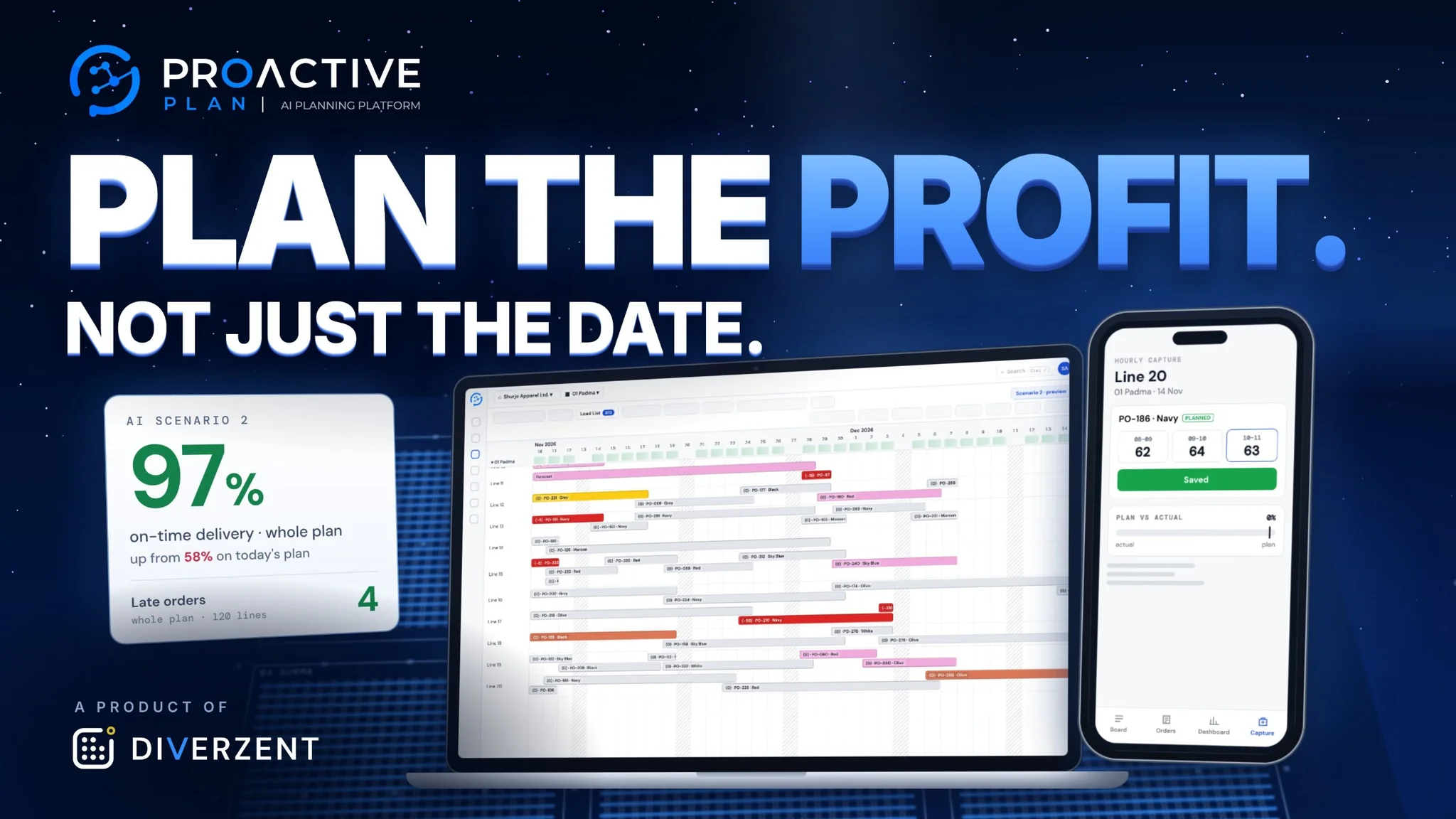
Order allocation, master scheduling, capacity and line planning, critical path, T&A and production monitoring — on a single board, with the financial outcome of every scenario visible before anything is committed.
The Profitability Gap
Two plans. Same ship date. Very different money.
Most planning systems in this industry answer one question well: can we ship on time? They rarely answer the second — is this the most profitable way to ship on time?
Two plans can hit every delivery date and still differ materially in contribution per line per day. Which line runs which style. Whether a line stood idle waiting for the next order. Whether overtime was taken because it was needed, or because it felt safer.
That difference is real money. In most factories it is never measured, because the planning system was never asked to measure it.
On-time is a hard constraint. Profit is optimised within it.
- Optimises for
- Contribution per line per day
- Never traded away
- On-time delivery
- Same inputs, same plan
- Always — it is deterministic
- Final decision sits with
- Your planner
Scenario planning
Move the plan before you commit it.
A planner asks what happens if this order moves, that line takes the overflow, and the late block is pulled forward. ProactivePlan answers with a whole plan rather than a cell — and shows what the answer earns before anything is committed.
- Line 68
- Line 69
- Line 70
- Line 71
- Line 72
- Line 73
- Line 74
- Line 75
- Line 76
The plan you are running.
Two lines are carrying late work, one is starved behind it, and one is holding a gap nobody has filled. Every one of these is visible today, and none of them is visible on a planning sheet.
A representation of the planning board, not a screenshot. It carries no data: strip widths show how a horizon is committed, the colours are the states the application uses, and the contribution bar is relative with no figure attached. The real board carries your orders, and that is what a demonstration is for.
The platform
What sits inside it.
Scenarios, ranked by what they earn.
A planner declares a policy. The optimiser returns candidate plans that obey it, each carrying its own P&L, and ranks placements by cost — cheapest feasible placement wins, with on-time never traded away.
- Deterministic and constraint-aware. The same inputs produce the same plan, every time.
- Every placement carries the reasoning behind it, so the plan can be defended.
- Scenarios are compared on financial outcome, not only on feasibility.
- Not a machine-learning model. It does not train on your data and does not drift.
Product footprint
From the order landing to the money it earned.
Planning is usually sold as a board. The board is the visible part — what decides whether it is worth anything is how far either side of it the system reaches.
- Order
Before anything is committed
- Order allocation
- Forecast capacity, converted
- Multi-factory from day one
- Ordering and production factory kept distinct
- Plan
The decision itself
- Master scheduling on finite hours
- Line and day placement
- Freeze horizon
- Forward or just-in-time
- Scenarios ranked on what they earn
- Supply
What has to arrive first
- Critical path
- Time and action
- Material readiness against the plan
- Supporting processes on the same board
- Floor
What actually happened
- Production capture
- Plan against actual, daily
- Simultaneous planners, per-order locking
- Audit trail of every edit and strip movement
- Money
The part most planning stops short of
- Contribution per line per day
- The P&L of a scenario, before committing it
- Board paper from your own figures
Everything above is running today. Where a capability is not yet shipped it is marked, because finding that out in week three of a deployment is a much worse conversation than reading it here.
How it works
Set the policy. Let the system find the plan.
A planner does not tune a schedule in ProactivePlan. A planner declares a planning policy, and the system returns scenarios that obey it — each with its financial outcome, calculated under exactly those rules.
Objective weighting
How much P&L, on-time and utilisation each matter in this scenario.
Freeze horizon
How many days of the committed plan the system may not touch.
Material and T&A readiness
Whether placement must respect T&A readiness, and how many days of slippage are tolerable.
Overtime discipline
Overtime is taken only where it converts a late order to on-time — never speculatively — within the factory’s daily hours ceiling.
Placement strategy
Forward placement, or just-in-time.
Cost optimisation
Whether the cost ladder is applied to find savings.
On-time is a hard constraint.
The optimiser maximises profit within plans that ship on time. It cannot trade a delivery date for a cost saving. An overtime variant that reaches the ship date always beats a cheaper plan that misses it.
The system proposes. The planner commits.
Scenarios never touch the live board. Nothing changes until a person approves it, and every placement carries the reasoning behind it.
Supply to the line
Know what will starve sewing.Days before it does.
Cutting, printing, embroidery and finishing all feed the same sewing line. ProactivePlan watches the whole chain and shows where a shortfall is building, while there is still time to move something.
- Fabric
Rolls issued to the cutting room.
Inside its window - Cutting
Panels for every style on the line.
Inside its window - Printing
Printed panels returned to the bundle.
Inside its window - Embroidery
Embroidered panels returned to the bundle.
Inside its window - Sewing
The line itself. Everything above feeds it.
Inside its window
Illustration, day 1
Every process is inside its window and the line is fed. This is the only day anyone looks at the plan and agrees with it.
Built for how apparel actually runs
It knows how a sewing floor behaves.
A planning director with twenty years on the floor will dismiss any financial argument unless the system understands their reality first.
- Finite capacity in hours, not slots
- Over-capacity is never permitted. Placement is a capacity flow against remaining hours per line per day.
- Learning curve on cumulative worked hours
- Indexed to hours actually worked, not calendar days. Where a planner chains sequential same-style runs on a line, the curve carries forward instead of restarting.
- Suborder-level granularity
- Contract, T&A, FOB, CM, style, ship date and PCD all live at suborder level. Multiple styles in one order, handled properly.
- T&A-gated placement
- Work is not scheduled before its pre-sewing prerequisites are in house, within a tolerance the planner sets.
- Multi-factory from day one
- Ordering factory and production factory are distinct, with visibility across sites.
- Concurrent multi-planner editing
- Several planners work one shared board at the same time, with server-side conflict detection. No per-user board copies, no scheduled hand-offs.
- Deterministic and explainable
- The same inputs produce the same plan, every time. Every placement carries its reasoning, and every edit is held in a permanent audit trail. You can defend this plan to your buyer.
Proof
In production, on real floors.
Eight
apparel manufacturers running ProactivePlan
Multi-site
groups planning across factories on one board
Suborder
granularity, end to end
A full customer study, with named outcomes, publishes when our reference customer has approved it.
Who it is for
The same plan, four different questions.
Chairman · MD · Owner
Margin erosion you cannot see or explain.
Two plans, same ship date, different money. You are almost certainly leaving contribution on the table, and it is not showing up in any report you receive.
CEO · COO · Executive Director
Firefighting, overtime cost, buyer escalations.
Test the plan before you commit it. See the cost of overtime, the cost of the safe option, and the cost of being wrong — before the line starts.
Planning · Production Director
Blamed for late shipments and low efficiency alike.
Set the policy once. Get plans that respect your freeze horizon, your T&A readiness and your overtime ceiling. On-time is never traded away.
IT Director · Digital Transformation
Integration risk, security, another desktop system to maintain.
Cloud-native and browser-based, with API-based synchronisation to your existing systems. No OS dependency, no intranet requirement, and a permanent audit trail of every edit.
Questions we are asked
The six that come up first.
Will AI take control away from my planners?
No. ProactivePlan generates scenarios. It never modifies the live plan. Nothing is committed until a planner approves it, and every placement carries its reasoning. Your planners gain options, not instructions.
Will it sacrifice my ship date to save cost?
No. On-time is a hard constraint in the optimiser, not a preference. Profit is maximised only within plans that ship on time — an overtime variant that reaches the ship date always beats a cheaper plan that misses it.
We already have an ERP.
Your ERP records what happened. ProactivePlan decides what should happen. They are different jobs, and they stay consistent through API-based synchronisation rather than duplicated data entry.
Our planners manage fine on Excel.
Excel can produce a feasible plan. It cannot compare the financial outcome of two feasible plans across a large operation, and it cannot enforce finite capacity, learning curves or T&A readiness. The question is not whether your planners can plan. It is how much contribution is lost in the plans they never had time to test.
How do I know the plan is correct?
Because it is deterministic and explainable. You set the policy, the system obeys it, the same inputs give the same plan every time, and every decision carries its reasoning. You can defend this plan to your buyer.
Cloud means our data leaves the factory.
The platform runs in regional cloud infrastructure, so data resides in-region rather than offshore, with row-level security on every table and a permanent audit trail. Access is governed by role and by factory, so a user sees only the sites they are assigned to.
What is the gap worth in your factory?
Enter your line count, working days and average efficiency. The calculator returns a defensible estimate of the contribution your current planning approach is leaving on the table — with the arithmetic shown, so you can argue with it.
No form. Nothing to fill in before you see the number.
See the financial outcome of your own plan.
The most useful first conversation is not a presentation. Bring a month of your own order book and we will run the arithmetic against it.
We answer within one working day.